Showing posts with label Reading Readiness. Show all posts

Friday, June 21, 2013

Online Reading Links

As teachnology is on a constant rise, children are spending more and more time with it. I am taking courses in my Masters about incorporaring technology not just in the classroom but also at home. Here are some links that children and families can access on their computers. I have yet to try them on tablets or iPads but they definitely work on the computer.


Tumble Books has an online collection of e-books for children and families (focus on elementary schools).


Children have choices in parts of Clifford stories making it interactive and fun for kids.


Little Critter stories online.


Screen Actors Guild Foundation (SAG) is  an online streaming video program featuring SAG members reading children’s books aloud.

Thursday, May 23, 2013

19 Storytelling Techniques

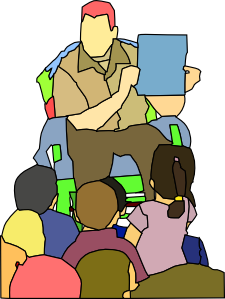
http://www.clker.com/cliparts/2/R/E/V/j/Q/reading-story-book-to-kids-md.png
I have been meaning to write a post about storytelling techniques for quite sometime. I have finally gotten a few minutes in my super busy schedule to come up with one! Here is a list of a few techniques I have used and some I haven't (but learned about them when I was doing my undergrad). Enjoy! Oh, and please post some other ideas that you know of or use in your classroom!


Felt Stories


Tell a story using felt! It allows for great visuals especially for books that may have patterns. An example of how I did a felt story can be found here: Silly Sally - Felt Storytelling Technique

Finger Puppets

http://www.csc.gov.sg/html/newsletter/aug2006/augpictures/FINGERPUPPET.jpg

Using finger puppets are so engaging! Use them while you are reading or tell a story without the book. Works wonders each way! A fun story that I always like to do is The Three Little Pigs. 

Puppet Show

http://blog.ljcfyi.com/ljcsProjects/craftiness/puppetShow1.jpg

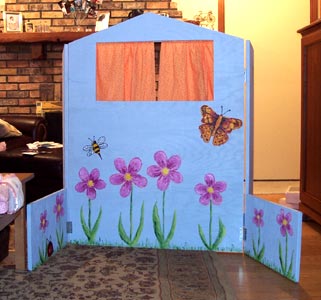
Oh my! What a fantastic idea to create your own puppet theatre! Use one of those 3-panel presentation boards (they cost around 8 dollars from Staples)! Got this picture from Google images and has now inspired me to create my own puppet theatre!

Stick Puppets

http://www.thevirtualvine.com/images/nurseryrhymes/heydiddlediddle/stpup.jpg
Tell a story with stick puppets. Just as much fun as any other technique! Remember, any of these techniques work with poems and songs as well!

Cut a Story

http://www.countryliving.com/cm/countryliving/images/cut-shape-0908-de-38555813.jpg
As you read the story, cut out a shape that may represent the shape. For example, "The girl was waiting for a valentine to arrive"; You can cut the shape of a valentine as you tell the story.

Draw a Story
and
Create a Class Story


Okay, I LOVE using this technique. That is a story that I drew in my classroom this year on the whiteboard. It can also be done on chart paper and then posted in the room. I chose to do it on the whiteboard. My students actually came up with this whole story on their own. Each child was given the opportunity to create the story. We started in a circle. One student gave one sentence. And the next student gave the next sentence of the story. We came up with this class story. Then they went to the desks and drew a picture of what their creation of the story was. It also became a class storybook! 

Real Props


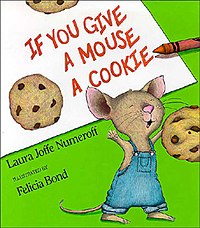
http://upload.wikimedia.org/wikipedia/en/thumb/3/3c/If_you_Give_a_Mouse_a_Cookie.jpg/200px-If_you_Give_a_Mouse_a_Cookie.jpg

This is one my most favourite stories! I have used this technique many times during my teaching experience. I used the book If You Give a Mouse a Cookie by Laura Numeroff. I bought all the props (from the dollar store) needed from the story and put them in order of the story in the basket. As I read the story, I pulled out the item/prop and laid it in front of me. The kids love it and so do I!

Role Play

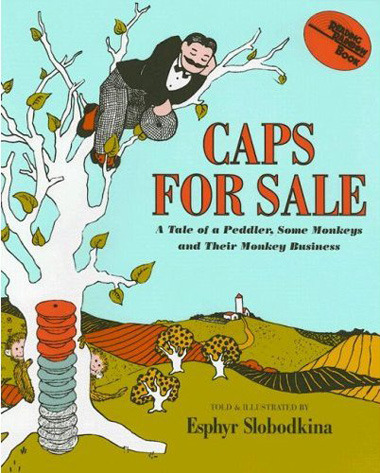
http://25.media.tumblr.com/tumblr_m2snatNJc81rsthpao1_400.jpg
Role play the story! You can add students as you go along. I did it with my students and they loved it! Caps for Sale is awesome to read! Grab a bunch of hats as props and you're good to go!!! Here we can build role playing and theatre skills!

Storybox Technique


http://www.margiepalatini.com/wp-content/uploads/2010/04/moosetache.jpg

Fun way to have a few props in the box. An easy carry-with-you-anywhere box with all the things you need for the story. Check out my post Moosetache to find out how I did mine!

Musical Instruments

http://www.kidstylefile.com.au/wp-content/uploads/2008/05/kidsgiftlist_musical-instruments.jpg

http://studio3music.com/wp-content/uploads/2009/07/mortimer.jpg

Simple! Use musical instruments while you tell your story. Mortimer is a great one to use. Check out my post to learn more about how I used Mortimer in my classroom. 

Clothesline

http://www.harpercollinschildrens.com/harperchildrensImages/isbn/large/9/9780694010769.jpg
https://blogger.googleusercontent.com/img/b/R29vZ2xl/AVvXsEjXYtAljoZzFP268vrL8f4PizjKIyNdlVMK2q6pIRBc-G2uBvhzvHConQAzZ1qsNaoT1a8LAKGyatacghWofiaaFxkpD3yl4jkJiCaXLiOoNbpbb8lJp8EnEk50OTYfqQSJX07Bk9EIGyWL/s1600/Mrs+McNosh+007.JPG
Get a strong clothesline. Buy some clothespins. Get pictures for the story (make from felt or photocopy the pages of the book and laminate them for forever-use). As you read the book, ask a child to put the corresponding item on the clothesline. This book is fantastic for it! 

Flashlight Fun

http://mindcemetery.net/wp-content/uploads/2011/09/kid-with-flashlight.jpg
Reading a story is SO much fun with the lights turned off and blinds shut. Make the room dark and turn on a flashlight!!! I love this technique. So much fun to do at any time of the day. Gives children a change and lets them know that reading can be done during the night as long as you have a flash light!!


Large Books

http://www.makeandtakes.com/wp-content/uploads/2007/06/big-books-008.jpg
Large books are great because the kids can see the pictures and words in a much bigger size! Awesome to listen to!

Other techniques can include: Singing chants during a story/song (We're going on a bear hunt), Physically participating (stamping feet, clapping hands), Use stuffed animals to tell a story, Word Cards/Pictures (when they hear a part of the story, they hold up their card/picture), and Hear and Respond (every time they hear a certain word, they must respond with an action/chant. Ex., "little frog" say ribbit ribbit or jump 3 times). 

Friday, October 5, 2012

Recognizing Alphabets - Matching Centre


I have been trying to put out different activities every other day in the literacy centre. Here is an alphabet centre that was donated to me by a teacher (I hit a jackpot with it because it was free!!!) If you are unable to buy it, I think it is super easy to create it as well (take a large bristol board, add pocket cards, label them with letters, cut out letters small enough to fit into the pockets and you are done!)

I only put out letters for now in a basket. As the weeks go by, there are picture cards with the whole word. The first letter is highlighted so they may match it and put it in the right pocket.

I put this centre on a round table. It is easier for more children to participate at one time rather than up on the wall or board. 


Here are my kids working away! I did not even model this activity to them. They all knew what was expected which is super easy!

What are the children learning?

  • communication and social skills as they use this centre with other children and learn to take turns
  • sorting skills as they take the letters and sort them accordingly
  • matching skills as they match the letters accordingly
  • hand-eye coordination as they use their eyes to match the letters and use their hands to insert them into the pockets
  • literacy skills as they recognize their letters (both upper and lower case)
  • math skills if they are counting how many letters are in the alphabet
  • observation skills as they figure out the differences between upper and lower case letters
  • gross motor (large muscles) as they use their hand to insert the letters and insert them into the pockets

Thursday, October 4, 2012

Recognizing Alphabets - Media-Enriched Activity

One of the easiest and realistic ways for children to begin recognizing letters is to use media around them. This is such an easy activity where children can learn their letters. All you need is newspapers/flyers and yellow marker/highlighters. 

I wrote down the letter that we are working on. I also send this activity as an at-home activity. It is easy for parents since they don't have to purchase anything to work with their children.

The goal is to highlight every S you see in the flyer or newspaper. If you don't have highlighters or markers, use pencil or pen to circle. And there you have another activity for learning alphabets! Choose a different letter each week and you have a centre ready!

Wednesday, October 3, 2012

Practicing Alphabets - Quick Activity

Here is a very quick letter activity I came up with. I was using the die cutter to cut out alphabets and I noticed there was a lot of paper left for recycling which I didn't feel comfortable recycling. So I decided to use it for learning letters. 

We are doing the letter S for the week. So I only used the letter S.
I put out paper, markers and crayons. You also choose to use paint. Finger painting would be fantastic for tiny fingers!

Here are my kids doing the activity. I allow them to start from the top or bottom. Whatever helps them make the S.
Here is the finished product. It was their first time but we are getting the point!


Sunday, August 5, 2012

Moosetache - Shoebox Storytelling Technique


Source: http://www.margiepalatini.com/wp-content/uploads/2010/04/moosetache.jpg


Here I am with another storytelling technique. I love this book! It is a bit long for the younger age group but with the story box technique, the children will be on their toes waiting for the next page! I used the book MOOSETACHE by Margie Palatini.


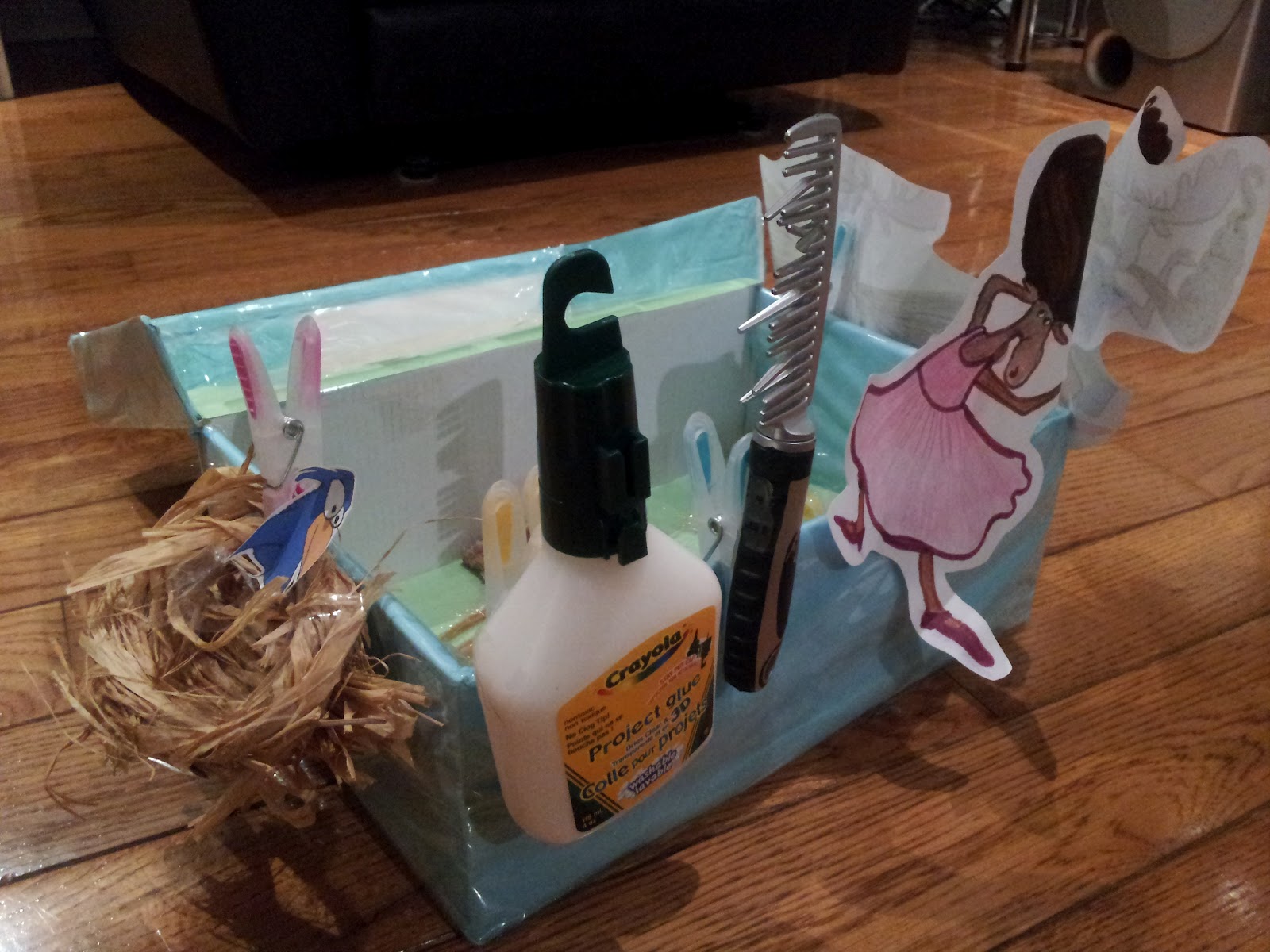
I used the shoebox technique for this book. I took a shoebox, covered it with tissue paper of bright colour and then put shiny gift wrap on it. You can choose to decorate it any way you want. Gift wrapping, newspaper, tissue paper, etc. Whatever you think will suit the book well. I then wrote the name of the book and the author so I am able to find it easily.


The mustache I made on my own because I was unable to find the right kind I needed. From the dollar store, I bought a ponytail wig and separated it in the middle with clear tape. I also stuck on masking tape at the back and believe it or not, I put the mustache on while I am telling the story (I become the character so to speak). 


On the inside of the lid, I wrote down all the materials I will be using according to chronological order. On the inside of the box I kept all the materials I would be using. 


I used clothespins with the materials. I just taped it around the item.


As I tell the story, I put the materials with the clothespins around the box. This technique is fast and easy to use once you have all the materials. The children love it and it moves away from the traditional reading of a story. 

Wednesday, August 1, 2012

Silly Sally - Felt Storytelling Technique

I can't believe how busy I have gotten in the past month. But I am back!!! A very happy summer to everyone and hope life is treating everyone with kindness, love and happy memories. 


I love books as do most teachers (I hope!). But what I love about books is the different amount of techniques it can be told in. Here is a felt story I created on my own with a bit of help using a website (I will post the link as well).


http://ak1.ostkcdn.com/images/products/muze/books/0152019901.jpg


Felt stories are one of the easiest ways to tell a story. It allows children to be focused if you are giving them opportunity to participate. I chose Silly Sally by Audrey Wood as it is one of my favourite books; it is fun, catchy (because it has rhyming words) and it can be used where children can participate while the story is being read. This allows children to look forward to the story and what is coming up next. 


I bought red felt because it is bright and attracts children to keep their focus. You can choose to put the felt with magnets on a magnetic board or pin it up on a cork board. 


I took printables from the above website and colored them in according to the characters from the story. I also photocopied some parts from the storybook in color so more children could participate throughout circle time. Then I laminated them so I can use them for a long time.


I bought pre-stick velcro from the dollar store and cut it into small pieces. Then I stuck them on the back of the pictures.


You can read the story at school on your choice of boards or you can do a small group story even on the floor. Don't forget to use this technique at home as well. It's a lot of fun!


I am also excited to share another blog, The Educator's Spin On It that has a post full of activities inspired by Audrey, Don and Bruce Wood. This blog has a post on a Virtual Book Club. Check it out, you'll love it!

Friday, May 25, 2012

List of Books - Preschoolers and Kindergarteners


Source: http://www.epikardia.com/images/kindergarten%20girl%20reading.jpg

The list of books for infants and toddlers have been done. It is time for a very short list for preschoolers and kindergarteners! These books are the most favourite books for this age group of all time.

Be sure to check out the other lists:
List of Books - Infants
List of Books - Toddlers

and the post Tips for Reading Aloud

Abiyoyo - by Pete Seeger
Alexander and the Terrible, Horrible, No Good, Very Bad Day - by Judith Viorst
Bedtime for Frances - by Russell Hoban
Blueberries for Sal - Robert McCloskey
Bread and Jam for Frances - by Russell Hoban
Brown Bear, Brown Bear, What do you see? - by Bill Martin, Jr.
Can I Keep Him? - by Steven Kellogg
The Cat in the Hat - by Dr. Seuss
Changes, Changes - by Pat Hutchins
Chicka Chicka Boom Boom - by Bill Martin, Jr.
Chicken Little - by Steven Kellogg
Corduroy - by Don Freeman
The Doorbell Rang - by Pat Hutchins
The First Snowfall - by Anne and Harlow Rockwell
Flossie and the Fox - by Patricia McKissack
Flying - by Donald Crews
Frog on His Own - by Mercer Mayer
Goldilocks and the Three Bears - by Jan Brett
Green Eggs and Ham - by Dr. Seuss
Hello Kangaroo - by Nan Bodsworth
Henny Penny - by Paul Galdone (illustrator)
I Don't Want to go to School - by Christine Harris
If You Give a Mouse a Cookie - by Laura Numeroff
If You Give a Pig a Pancake - by Laura Numeroff
Imogene's Antlers - by David Small
Island of the Skog - by Steven Kellogg
It's Pumpkin Time - by Zoe Hall
Jamberry - by Bruce Degen
The Judge - by Margot and Harve Zemach
Just like you and Me - by David Miller
Koala Lou - by Mem Fox
Leo the Late Bloomer - by Robert Kraus
A Letter to Amy - by Ezra Jack Keats
Look Book - by Tana Hoban
Make Way for Ducklings - by Robert McCloskey
The Mitten - by Jan Brett
Mouse Paint - by E.S. Walsh
The Napping House - by Audrey and Dan Wood
Over in the Meadow - by Ezra Jack Keats
Owl Moon - by Jane Yolen
Pancakes for Breakfast - by Tomie DePaola
Picasso the Green Tree Frog - by Amanda Graham
Rosie's Walk - by Pat Hutchins
Silly Sally - by Audrey Wood
The Snowy Day - by Ezra Jack Keats
Swimmy - by Leo Lionni
Titch - by Pat Hutchins
Tough Boris - by Mem Fox
The Very Busy Caterpillar - by Eric Carle
Wacky Wednesday - by Theo Le Sieg
Whistle for Willie - by Ezra Jack Keats
Zoom - by Istvan Banyai

Please remember this is a VERY short list of books. There are ton of others depending on the interest of your student(s) and child(ren).

Sunday, May 20, 2012

Tips for Reading Aloud

I have mentioned in a previous blog that reading aloud to children should begin when the baby is still in the womb. "An infant's hearing is wired well enough by the fifth month in utero to hear sounds outside the womb" (as written by Pam Schiller in 'Creating Readers'). Here are some tips for reading aloud to children.


Source: http://www.soulemama.com/.a/6a00d8341c4ea853ef01156fb9db90970b-500wi

1. Find a comfortable setting. Reading "nooks" or "corners" are sort of a haven for children. It is a place where they can relax and read at their own time, based on their own interests.

Source: http://i00.i.aliimg.com/photo/v0/221690262/children_book_color_educational_book.jpg


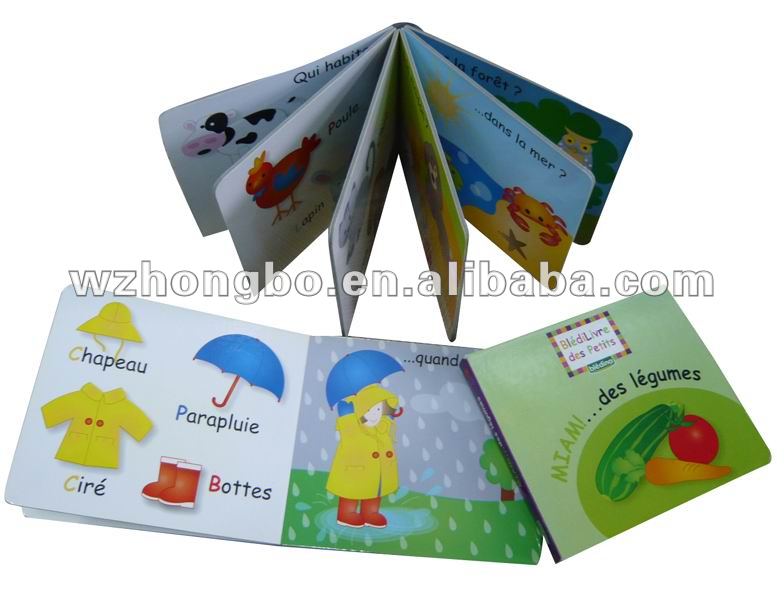
   2. Make sure children can see the pictures. Pictures are worth a thousand words. Children are able to create their own story line based on what they see in the pictures. It is one of the most important parts in learning how to read.


Source: http://www.mhl.org/kids/fun/wp-content/uploads/2009/05/bird.jpg


   3. Choose books that are appropriate for the age level of the child. Children should not be given that are too low for them because they will get bored or too high for them because they will lose their interest. 

Source: http://www.kidsbooks.ca/i/481D_3.jpg

4. Read books on diverse topics and things of interest to children. When given the opportunity to learn about diversity, children are the best audience to accept diversity as well. 

Source: http://farm5.static.flickr.com/4107/4994338886_9072242c4d.jpg

5. Build background knowledge. Let children examine the cover of the book. Give them a chance to predict what the story might be about. During reading, ask them to predict what will happen next. Ask questions about vocabulary that is new and difficult. Prediction is a big part of critical thinking.

Source: http://www.torontoobserver.ca/wp-content/uploads/2008/03/25-01-08-McKay-Munsch3.jpg

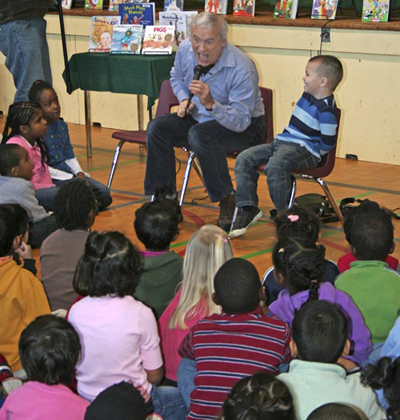
6. Use good expressions as you read, just like Robert Munsch is in the above picture! Change your tone, rhythm, level of your voice to fit the situation in the story. Be soft, quiet or excited/surprised. 

Source: http://creativecurio.com/wp-content/uploads/2008/04/ross-book.jpg

7. Re-read favourite books! If the children want to hear the same story everyday, let them. Repetition is one of the best ways for children to become comfortable with listening, predicting and reading.


* One last thing: If the child is not interested, don't continue reading. You don't have to finish reading a book that no one wants to hear*

Saturday, May 19, 2012

List of Books - Toddlers

I have posted before a reading list for infants. Now it's time for toddlers. Here it is as found in the book 'Creating Readers' by Pam Schiller:


Animal Crackers - by Jane Dyer
The Animal Orchestra - by Scott Gustafson
Barnyard Banter - by Denise Fleming
The Best Mouse Cookie - by Laura Numeroff
Big - by Keith Haring
Can You Guess? - by Margaret Miller
Dots, Spots, Speckles, and Stripes - by Tana Hoban
The Earth is Good - by Michael Demunn
Exactly the Opposite - by Tana Hoban
Eyes, Nose, Fingers and Toes - by Judy Hindley
Five Little Monkeys Sitting on a Tree - by Eileen Christelow
Flower Garden - by Eve Bunting
Frozen Noses - by Jan Carr
Good Day, Good Night - by Marilyn Singer
Growing Vegetable Soup - by Lois Ehlert
Have You Seen Bugs? - by Joanne Oppenheim
Hello Toes! Hello Feet! - by Ann Whitford Paul
Hey, Little Baby! - by Nola Buck
Horatio's Bed - by Camillea Ashforth
In the Small, Small Pond - by Denise Fleming
Inside, Outside, Upside, Down - by Stan and Jan Berenstein
Is It Red? Is It Yellow? Is It Blue? - by Tana Hoban
I Went Walking - by Sue Williams
Let's Go Visiting - by Sue Williams
Little Red Hen and the Ear of Wheat - by Mary Finch
Lunch - by Denise Fleming
Mrs Wishy-Washy - by Joy Cowley
My Five Senses - by Margaret Miller
Nature Spy - by Shelly Rotner
One Fish, Two Fish, Red Fish, Blue Fish - by Dr Seuss
Planting a Rainbow - by Lois Ehlert
Shapes, Shapes, Shapes - by Tana Hoban
Snowy, Flowy, Blowy - by Nancy Tafuri
Teddy Bears' Picnic - by Jimmy Kennedy
These Hands - by Hope Lynn Price
Time for Bed - by Mem Fox
Toddlerobics - by Zita Newcome
Up the Ladder, Down the Slide - by Betsy Everitt
Wake Up, Little Children - by Jim Aylesworth
What Makes Me Happy? - by Catherine and Laurence Anholt
When the Teddy Bears Came - by Martin Waddell
Where Does It Go? - by Margaret Miller
While You Were Sleeping - by John Butler
Who Hops? - by Katy Davis
Who Took the Farmer's Hat? - by Joan Nodset
Who Uses This? - by Margaret Miller

Saturday, May 12, 2012

Making Your Own Tactile Books!


A lot of parents and teachers talk about how expensive books are these days. I can agree to some extent but I also think a great book is worth paying the extra few bucks. On the other hand, who doesn't like to save money!?


My good friend Nothy has shared two very helpful links if you would like to make your own tactile books for infants and toddlers. If you are an artsy person and love to sew, these links are for you. If you would like to pursue a new love for sewing, then this is for you too. Please check out Nothy's blog Aft Agley where she shares so much information, knowledge and ideas about sewing! It is worth your while.

Here are the links for creating your own books:

Thursday, May 10, 2012

List of Books - Infants

Babies are masters at one thing: putting everything in their mouth. This is because they use their taste senses to get a feel of everything. If it doesn't taste bad, it is heaven! 

Books need to be full of different textures that infants can touch, smell, see, hear and of course do the taste test. Most baby books are made out of cloth because they can be easily washed. Usually, every page consists of bright colors to see, something they can feel (different fabrics/papers/sealed liquids), something they can hear (rattles/bells/squishy sounds), something (quite rare) they can smell. 

A lot of cloth books are created by the company Lamaze and can be found at baby stores, Toys-R-Us and Walmart. 

Here is a list of books that are great for infants to read to. These titles are not always found in cloth-form; only board style. Make sure your babies don't put these in their mouth for a taste test!

Animal Crackers - by Nancy Dyer
Baby Faces - by Margaret Miller
Baby! Talk! - by Penny Gentieu
Big Fat Hen - by Keith Baker
Bounce Bounce Bounce - by Kathy Henderson
Clap Hands - by Helen Oxenbury
First Steps - by Lee Wardlaw
How a Baby Grows - by Nola Buck
Hush Little Baby - by Sylvia Long
I See - by Rachel Isadora
Itsy Bitsy Spider - by Iza Trapani
Moo, Baa, La La La! - by Sandra Boynton
Mother Goose Magic - by Kay Chorao
Nighty-Nighty - by Dawn Apperley
Of Colors and Things - by Tana Hoban
Pat the Bunny - by Dorothy Kunhardt
Pickle and the Box - by Lynn Breeze
Sleepytime Rhyme - by Remy Charlip
What's on My Head? - by Margaret Miller
Who Says Moo? - by Ruth Young
Yellow Hat, Red Hat - by Basia Bogdanowicz

Wednesday, May 9, 2012

Sounds of Language - Rhymes


The two best things about rhymes are that they are fun and they are predictable. Children need prediction to improve their reading skills,  writing skills and communication skills. You can use poems, songs, puzzles, word families, and rhyming games to learn rhyming. Don't forget to read them books that are full of rhyming.


Poem - Fire! Fire!
"Fire! Fire!" said Mrs. McGuire.
"Where? Where?" said Mrs. Bear.
"Downtown!" said Mrs. Brown.
"What floor?" said Mrs. Moore.
"Near the top!" said Mrs. Kopp.
"What a pity!" said Mrs. City.
"Here I come!" said Mrs. Plum.
"Water! Water!" said Mrs. Potter.
"Get out of my way!" said Mrs. Lei.
"Let me see!" said Mrs. Chi"
"Break down the door!" said Mrs. Orr.
"Oh, help us and save us! said Mrs. Davis,
As she fell down the stairs with a sack of potatoes. 

Song - Down by the Bay
Down by the bay, where the watermelons grow.
Back to my home, I dare not go.
For if I do, my mother will say,
"Did you ever see a pig dancing the jig?"
Down by the bay.

Other rhyming phrases:
...whale with a polka-dot tail.
...bat wearing a hat.
...rat chasing a cat.
...dog playing leapfrog.
...bear combing his hair.
...bee with a sunburned knee.
...moose kissing a goose.
...goat sailing a boat.


Use puzzles and word cards that allow the children to put the pieces together according to their rhyming partner. The best kind are the ones with the picture and the word written on them.


Word families are the way to go for younger children. I like to cut out a big tree from construction paper and put it on the wall. One week I would call it our "AT" word family tree. Then on different branches I would stick pictures with their words. Here is what it would look like.


Rhyming Games
There are tons of fill-in-the-blank rhyming games you can play.

I like oranges, I like to feel them,
But I can't eat them until I _________ (peel them).
Peaches are juicy, peaches are round,
When you shake the tree, they fall to the ______ (ground).

A banana is yellow and shaped like the moon
When it's in pudding you eat it with a _____ (spoon).

Pears are golden, juice, sweet, yummy.
And round at the bottom like Santa's ______ (tummy).


Matching games are fun to do too!

Stories
Read books that are full of rhyming.

A-Hunting We Will Go - by John Langstaff
Anna Banana: 101 Jump Rope Rhymes - by C. Chapman
Brown Bear, Brown Bear - by Bill Martin, Jr.
The Cat in the Hat - by Dr. Seuss
Chicka Chicka Boom Boom - by Bill Martin, Jr.
Chicken Soup with Rice - by Maurice Sendak
Henny Penny - by Paul Galdone
A House is a House for Me - by Mary Ann Hoberman
In the Tall, Tall Grass - by Denise Fleming
Jamberry - by Bruce Degen
One Fish, Two Fish, Red Fish, Blue Fish - by Dr. Seuss
Quick as a Cricket - by Audrey Wood
Silly Sally - by Audrey Wood
Spiders Spin Webs - by Yvonne Winer
Related Posts Plugin for WordPress, Blogger...